Sleeping It Off: Can Weekend Lie-Ins Really Ease Teen Depression?
As melancholy among teenagers and young people rises, a new study has resurrected an old topic with renewed urgency: can extra sleep—at least on weekends—help safeguard young minds, or does it simply cover a deeper failure in how society organises education and work?
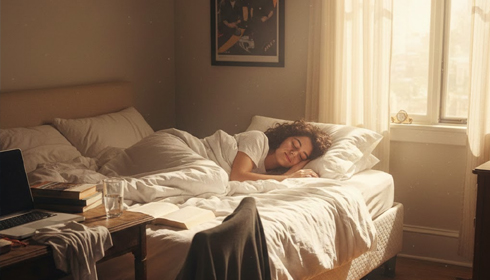
Researchers from the University of Oregon and the State University of New York Upstate Medical University found that young individuals aged 16 to 24 who caught up on lost sleep over the weekend had a 41% lower incidence of depressive symptoms than those who did not. The study, published in the Journal of Affective Disorders, draws on data from the 2021-23 National Health and Nutrition Examination Survey, a large, nationally representative US dataset.
The study focusses on what scientists refer to as "weekend catch-up sleep"—the extra hours that young people obtain on Saturdays and Sundays to compensate for a lack of sleep during the school or workweek. Participants reported their typical bedtimes, wake-up times, and daily moods, including whether they felt sad or depressed every day.
"Sleep researchers and clinicians have long recommended that adolescents get eight to ten hours of sleep at a consistent time every day of the week, but that's simply not feasible for many adolescents," said Melynda Casement, a licensed psychologist and associate professor at the University of Oregon who co-authored the study. She emphasised that regular sleep is still best, but weekend recovery sleep may still be "somewhat protective."
To see why the duration of sleep matters, consider teenage biology. During adolescence, the circadian rhythm, or internal clock, naturally shifts later. Teenagers become "night owls" in a nutshell. "Instead of being a morning lark, you will become a night owl," Casement explained. Most teens are naturally inclined to sleep around 11 p.m. and wake up around 8 a.m., which is very different from when school starts early.
When you don't get enough sleep, it builds up and makes you feel bad, lose focus, and have trouble controlling your emotions. Depression, a leading cause of impairment in individuals aged 16–24, is marked by enduring sadness, diminished energy, and difficulties in everyday functioning.
Many public health advocates say that sleeping in on the weekends can assist with depression symptoms, but they don't think of it as a cure. They say that sleeping in on the weekends is only a short-term fix, not a long-term solution. It helps young people deal with a broken system instead of fixing it.
Scholars assert that the core policy challenge is whether educational institutions and organisations are prepared to align their schedules with adolescent biological rhythms. Until then, sleeping on the weekends may help, but it won't be as good for your mental health as getting adequate sleep throughout the week.
Be first to post your comments